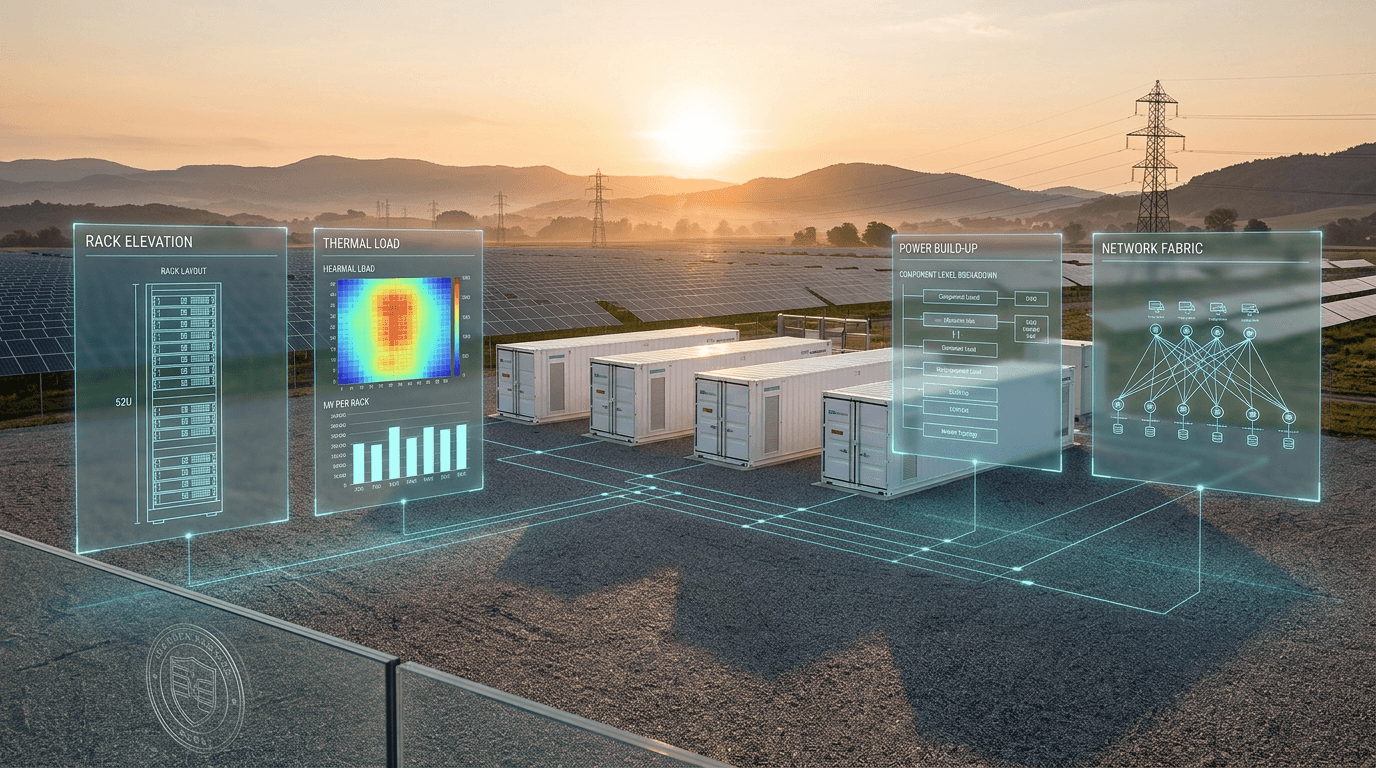
Basis of design for high-density compute: rack elevation, component-level power build-up, thermal design past the air-cooling limit, network fabric specification, and ROM budgeting with vendor data cited and assumptions flagged.
AI compute is now an energy problem. The constraint on deployment is rarely the hardware — it is power, heat and a grid connection that may not exist yet. We engineer the infrastructure side of that problem.
 AI data center infrastructure
A modular data centre built as an integrated platform rather than an empty shell fitted out later. Compute, power distribution, energy storage, thermal management, network fabric and controls are engineered together, so the building and the load are sized against each other from the start.
It can be deployed as a standalone campus, co-located with generation, or placed behind the meter on a site that already has power available.
Revenue from day one. A compute platform earns as soon as it is energised. Unlike a shell built speculatively, there is no gap between capital spent and capacity sold.
A route around the connection queue. Where the network is constrained, pairing compute with on-site generation and storage can make a project deliverable on a timescale that waiting for a grid upgrade cannot match. This is the same engineering logic we apply to storage siting, and it is the difference between a project that proceeds and one that sits in a queue.
Lower operating cost. Efficiency is set at the design stage, not recovered later. The choice of cooling architecture alone moves the overhead ratio materially, and that difference compounds across every hour of operation.
Send us the project. The principal engineer reads every request personally and replies in writing.
Class:Utility Scale Advisory
Compliance:EN European Grid Codes
Deliverables:Written reports with assumptions stated
Capacity that scales in defined increments. Adding capability is a planned step with known power, cooling and cost implications rather than a redesign.
Three things decide whether the economics work:
The most expensive mistakes are made before construction: undersized cooling, storage specified against the wrong technology, or a facility load that exceeds the shell it was designed for. Each is cheap to correct on paper and expensive to correct in the field.
Loads are built up from component data rather than assumed. Vendor-published figures are cited; anything not confirmed is flagged as an assumption to be validated before procurement. Budgetary figures are labelled as estimates and are never presented as quotes.
One observation worth carrying into any budget: the processors are only about half the cost of a populated rack. Host platform, memory, fabric and optics account for the rest, and budgets built on processor pricing alone routinely land at half the real figure.
If you are considering compute capacity on a site with generation, constrained grid access, or an existing energy asset, we can tell you early whether the numbers work — and what would have to be true for them to work.