
Project Development Support
TSO application preparation, permitting drawings, environmental layout checks, and microgrid controls advisory.
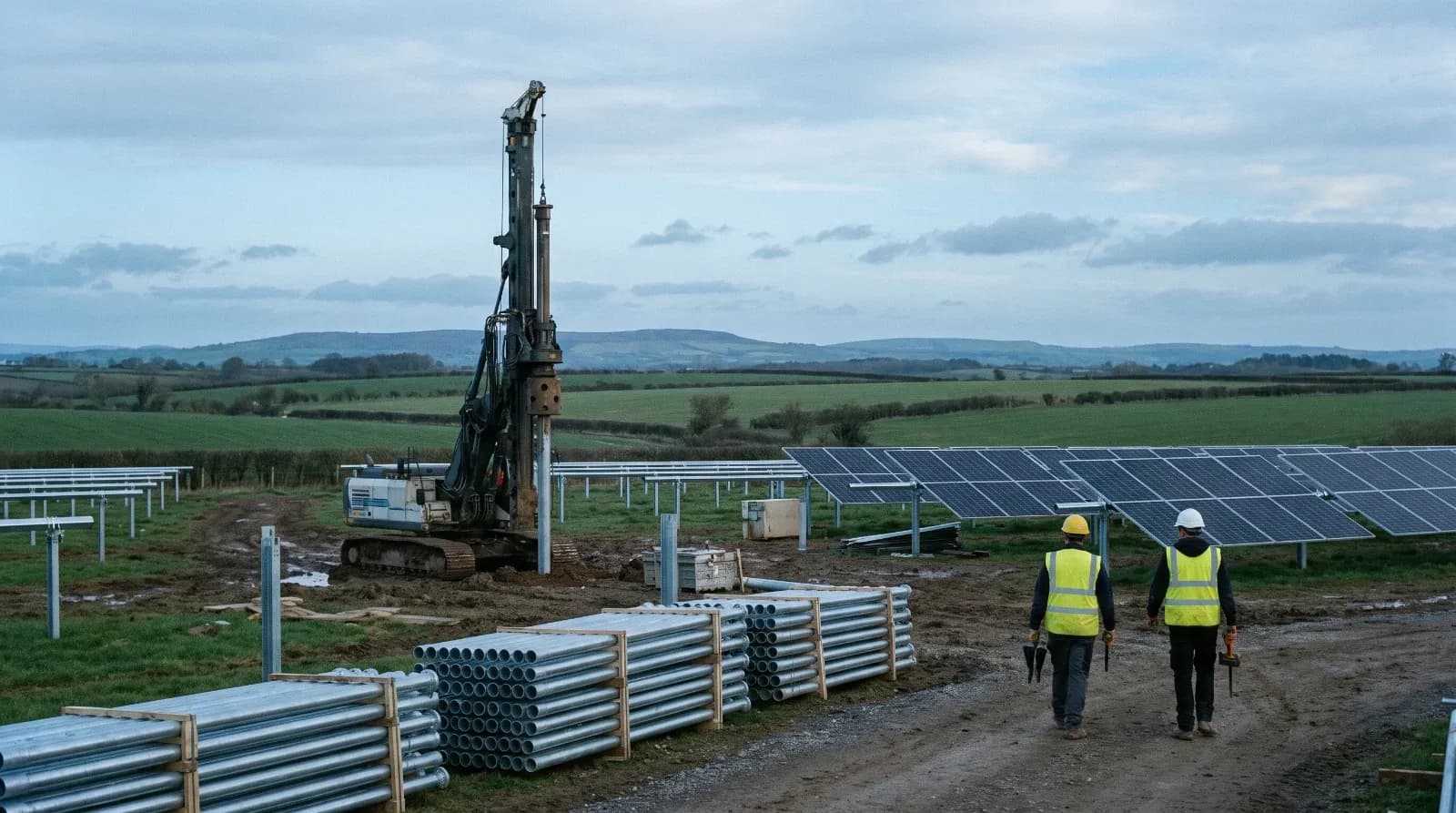
Detailed Scope & Specifications
Getting a project from site control to ready-to-build is mostly a documentation problem with a clock attached. The network operator, the municipality and the regulator each want a different package, in a different format, by a different date — and in Romania those dates now carry money. This is the work that produces those packages and keeps the sequence intact.
Grid connection applications to the TSO and DSO
A submission that comes back for clarification does not just lose the weeks it sits on someone’s desk. It loses its place in a queue that is moving.
- Network code conformity: grid integration studies built against the codes that will actually be applied — EN 50549-1 and EN 50549-2, the Romanian connection regulation, and the Polish transmission and distribution grid codes.
- Steady-state and dynamic studies: load flow, short-circuit contribution, reactive capability and fault ride-through, in the simulation format the operator requires rather than a format that has to be converted.
- Injection profiling against constraint: structuring the application so the export profile anticipates the transmission limits in that zone, which is what curtailment risk is actually made of.
Permitting drawings and civil design
- Site layouts: array geometry, tracker axes, BESS enclosures, inverter stations and substation footprint, drawn to what the zoning authority needs to see.
- Single-line diagrams: DC string configuration through the LV collection buses to the HV step-up, consistent across every document in the package.
- Civil and routing schemes: access roads, cut and fill, drainage, cable trenches, dimensioned to local civil standards rather than to a template.
Environmental and siting checks
These are the findings that force a redesign if they arrive late, and cost almost nothing if they arrive early.
- Acoustic modelling: inverter and BESS cooling noise against the limits that apply at the nearest residential boundary.
- Hydrology and runoff: slope, soil and drainage checked against erosion risk and regional water rules.
- Glint and glare: tracker geometry assessed against roads, airports and municipal boundaries before an objection is filed rather than after.
Controls for co-located generation and storage
- Plant controller and EMS architecture: how the PPC and the energy management system divide responsibility for real-time dispatch across co-located assets.
- Ancillary service telemetry: control logic for fast frequency response and arbitrage, specified against what the market actually settles on.
- Islanded operation: isolation and protection schemes that keep the asset intact through a disturbance on the wider network.
The authorisation clock, and what it now costs to miss it
On 21 May 2026 ANRE’s Regulatory Committee amended both the connection regulation and the licensing regulation. The changes are not cosmetic, and they decide how a development programme has to be sequenced. Published orders are searchable in the ANRE register.
- The ATR guarantee moved from 5 to 20 per cent of the connection tariff excluding VAT, for sites above 1 MW of total approved evacuation power.
- The establishment authorisation now has hard deadlines: 12 months from signing the connection contract and 18 months from ATR issuance, written into the framework contract. One extension of up to 12 months is possible, granted by the network operator, and only for documented reasons outside your control.
- A second guarantee of EUR 30 per kW of installed capacity is posted with the authorisation application and held until the completion certificate. It is executed if the project is not finished inside the authorisation period or if you withdraw, whatever the reason. On hybrids and repowering it is calculated on the increase between the original ATR and the updated one.
- Standalone storage is now explicitly inside the same regulation, framework ATR and framework connection contract, which removes an ambiguity developers had been reading either way.
For the capacity auctions the participation guarantee is EUR 20,000 per MW requested in 2026; from 2027 it becomes the lower of that figure and the capacity-weighted average of the previous year’s clearing prices, and it must be posted when the allocation request is filed rather than later. The procedure and its annexes are published by Transelectrica.
Calculation, design, and construction
The three do not have to be bought separately, and splitting them across three parties is where assumptions get lost.
- We calculate: yield and storage models, load flow, short-circuit and protection studies — the numbers the operator and the lender will each test independently.
- We design: layouts, single-line diagrams, civil and cable routing, control architecture, issued as a package that is ready for both the permit and the tender.
- And where a project needs it, we build: procurement support, contractor selection, site supervision and commissioning, carried through to a completed installation.
Related work
If the question is where to connect rather than how to file, start with Grid Connection Strategy. For a single position already held, the fixed-scope Grid Position Review answers it in two to three working days. Before a package reaches a lender or a grant panel, Pre-Submission Technical Review reads it the way their reviewer will. The published capacity data behind all of it is in Romania grid capacity by zone.
Consultation Request
Send us the project. The principal engineer reads every request personally and replies in writing.
Division Details
Class:Utility Scale Advisory
Compliance:EN European Grid Codes
Deliverables:Written reports with assumptions stated