
Battery Energy Storage Systems (BESS) Integration
Degradation modelling, thermal management and auxiliary load review for front-of-meter storage. We check that the capacity the model promises in year ten is the capacity the design can actually hold.
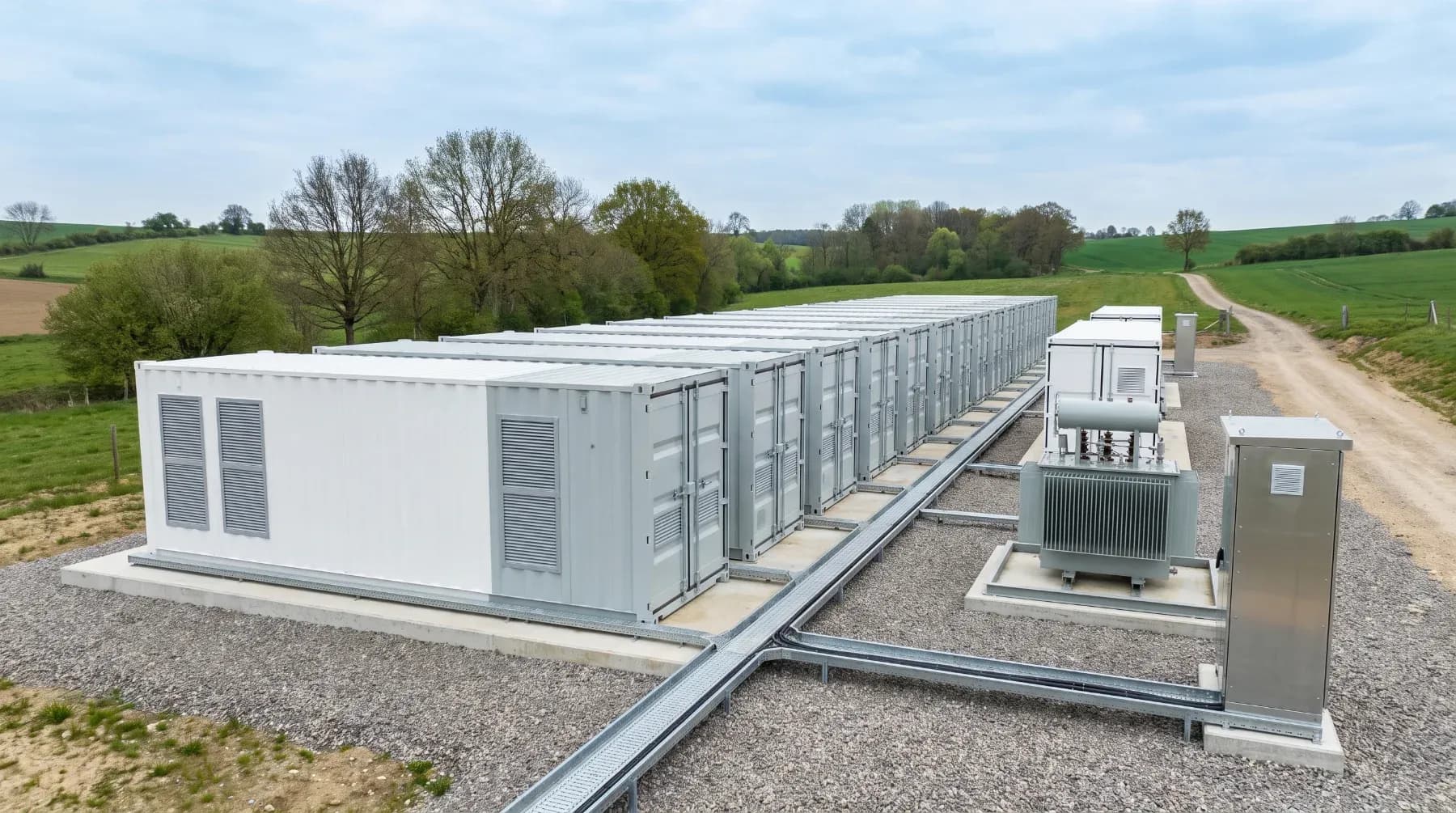
Detailed Scope & Asset Engineering
A battery on a European grid is not run the way its warranty was written. Frequency markets and negative midday prices impose a duty cycle that ages cells faster than any datasheet assumes, and the difference lands on capacity guarantees, on round-trip efficiency and on the revenue you can still bank in year ten. This work measures that difference before it is a surprise.
Degradation under a volatile duty cycle
Fast frequency products such as FCR and aFRR dispatch hard and often. Cells respond to that differently than they do to a daily arbitrage cycle, and a linear ageing assumption hides the gap entirely.
- State-of-health tracking: dynamic degradation modelling that maps the actual duty cycle onto capacity fade, in place of the supplier’s straight line.
- Impedance and deformation diagnostics: internal resistance and structural change monitored at cell level, to catch micro-shorts before they cost a string or a safety case.
- C-rate boundaries: charge and discharge profiles set to earn in the ancillary markets without spending time in the C-rate zones that deplete lithium inventory.
Thermal loops, audited independently
Temperature uniformity is what keeps cells matched. Everything downstream — capacity fade, propagation risk, warranty validity — follows from it.
- Liquid cooling verified by CFD: closed-loop performance analysed so the spread across modules stays within roughly two degrees inside the enclosure.
- Stagnation and hot spots: dead zones in the coolant distribution identified, since they age one part of the pack faster than the rest and the imbalance never recovers.
- Seasonal extremes: loop performance modelled from Nordic winter to Mediterranean summer, not at a single design temperature.
Auxiliary load and real round-trip efficiency
A realistic efficiency figure is AC to AC and includes everything the site burns to keep the battery available. That is usually the part missing from the model.
- Thermal management overhead: chillers, pumps and ventilation quantified as continuous consumption, which is what turns a DC figure into a bankable one.
- Standby drain: auxiliary consumption during long market standby simulated, because it decides both state-of-charge management and auxiliary transformer sizing.
- Into the cash flow: net parasitic losses carried into the financial model, so the data room survives a first review instead of a third.
Grid code and compliance evidence
- Storage standards and network codes: conformity checked against the IEC 62933 series and against the regional codes governing active and reactive power control and fault ride-through.
- Safety and deflagration: off-gas detection and passive venting audited against building rules and explosive atmosphere requirements.
- Warranty evidence: throughput logged independently against the supplier’s limits. A warranty is only enforceable with data collected before the claim.
Romania 2026: storage rules, funding and the revenue case
Romania recognised storage as its own asset class, then changed how it reaches the grid and how it gets paid. A storage project started under last year’s assumptions is already working from the wrong rulebook.
Storage has its own connection norm. Storage installations connect under the ANRE technical norm approved by Order 3/2023 (Official Gazette 53 of 19 January 2023), covering standalone storage, storage added to a generation site and storage inside a consumption site, together with the notification procedure. Getting that classification wrong at the ATR stage is one of the most expensive mistakes available in a Romanian storage project. Orders are searchable in the ANRE register.
Storage sits inside the new auction mechanism. New storage capacity is allocated through the same competitive process introduced by ANRE Orders 15/2026 and 16/2026, with the same EUR 20,000 per MW bid deposit and the same 20 percent connection guarantee as generation. Daily auctions start on 30 October 2026, under the procedure published by Transelectrica.
There is public money, awarded competitively. On 5 March 2026 the European Commission approved a EUR 150 million Romanian scheme for new standalone battery storage, financed from the Modernisation Fund and awarded by competitive tender, targeting at least 2,174 MWh of new capacity. It is Romania’s first measure cleared under the Clean Industrial Deal State Aid Framework. Competitive tenders reward applications whose technical case holds up.
Volatility is the revenue case and the degradation risk. Negative prices and forced curtailment on sunny low-demand days are exactly what makes storage worth building here, and exactly what makes real duty cycles harsher than the datasheet assumes. We model the cycling the Romanian market will impose, then show what it does to state of health, warranty limits and net revenue over the financing period.
Bulgaria 2026: Europe’s fastest storage market, and its trap
Bulgaria went from almost no storage to one of the highest battery-to-grid ratios in the world in about three years. That creates opportunity and a crowding risk at the same time.
Connection carries a hard financial commitment. Storage investors post a deposit or bank guarantee of 50,000 leva per MWh of connected capacity, roughly 25,600 euro per MWh at the fixed conversion rate. That is real money committed before construction, and it makes the accuracy of your capacity and configuration decisions financially immediate.
The subsidy pipeline is large and competitive. The RESTORE programme, funded from the Recovery and Resilience Facility, put around 590 million euro behind storage. The first round awarded about 587 million euro across 82 projects, a later round added 117.6 million euro for 31 projects above 4 GWh, and the standalone call was oversubscribed more than four times. Tenders at that ratio are won on technical quality, not on ambition.
The system is filling up fast. ESO counted about 3,432 MW of storage on the system by May 2026, and more than 14 GWh has been awarded across the national tenders since 2023. Every additional battery competes for the same arbitrage spread and the same balancing volumes.
That is exactly why the cycle model matters. Deep negative prices and southern curtailment are the earning opportunity, and they are also what drives aggressive cycling. We model the duty cycle the Bulgarian market will actually impose, then show its effect on state of health, warranty limits and the revenue you can still bank in year ten.
What you get
Duty-cycle and degradation modelling against real market data, auxiliary load and round-trip efficiency verified rather than assumed, grid-code and notification conformity checked against the norm that applies to your configuration, and a technical file structured to survive both a lender and a tender panel.
Related work
For the connection the project depends on, see Grid Connection Strategy; for the application and permitting packages, Project Development Support. Once the plant is running, Performance Analysis measures what it actually does, and Technology Selection covers the hardware choice behind it.
Consultation Request
Send us the project. The principal engineer reads every request personally.
Segment Details
Sector:Battery Energy Storage Systems (BESS) Integration
Compliance:EN IEC 62933 and grid-code conformity
Primary Focus:State of health across the contract term, black-start capability, and duty cycle against the revenue case.
Send us a project and we will look at it
Site data, a yield model, a design package or a report you want a second opinion on. We come back with what we would check first — no charge for the first look.
Send a project