
Utility-Scale Solar PV Engineering
Array layout, cable sizing and reactive power capability, checked against the grid code before the connection application goes in. Most of what holds up commissioning is decided at design stage, where it is still cheap to fix.
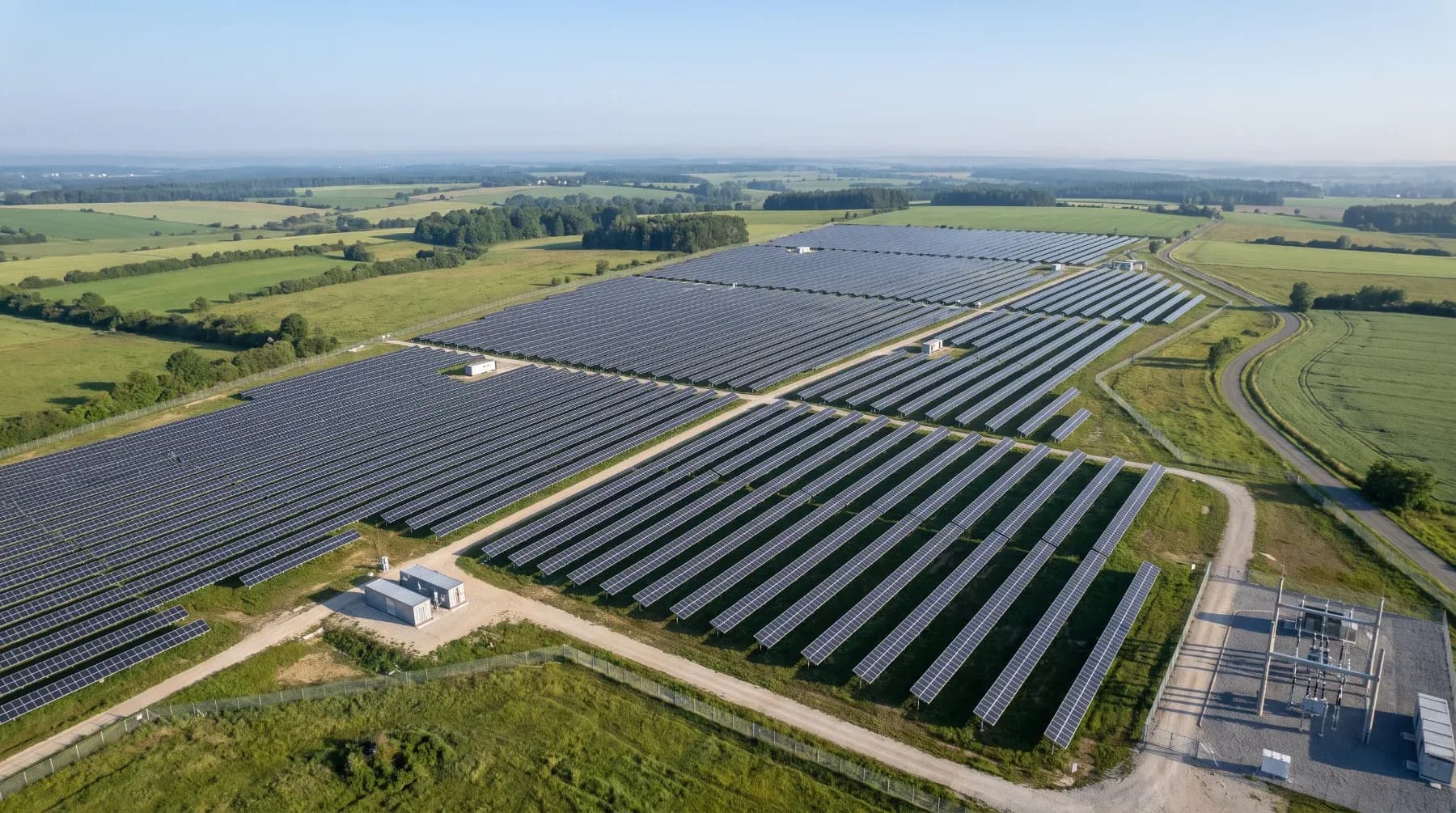
Detailed Scope & Asset Engineering
Most of what delays a utility-scale solar plant is decided at design stage, months before anyone notices. The layout that forces expensive grading, the string configuration that fails a test, the reactive capability the operator asks for and the design cannot deliver. This is the engineering that settles those questions while they are still cheap to settle.
Array layout and spatial engineering
European sites are rarely flat and rarely generous. Layout is where land constraints, civil cost and energy density are traded against each other.
- Terrain-adaptive modelling: tracker and fixed-tilt layouts built on digital elevation data so the structure follows the ground, instead of the ground being regraded to suit the structure.
- Row-to-row shading: backtracking behaviour simulated in PVsyst for the low-angle morning and evening hours, which is where inter-row losses actually occur.
- DC-to-AC ratio: overloading set against the local irradiance profile, so inverter utilisation is high without running the equipment hot for years.
Grid compliance and dynamic response
A connection permit is granted against technical conformity, not against intent. The controls have to exist in the design before they can be demonstrated on site.
- Reactive capability: power factor and Q/P envelope calculated against what the operator will require at your point of connection, not against the inverter datasheet.
- Fault ride-through: the conversion system verified to hold through voltage dips rather than disconnecting, which is the behaviour the compliance test is designed to catch.
- Plant controller integration: communication between site SCADA and the operator specified so that curtailment instructions and frequency response work on the day they are first used.
Balance of plant, and where the losses hide
Twenty years of small electrical losses is a large number. Most of it is fixed by decisions taken in a week.
- String configuration up to 1500 V DC: sized to reduce cable cross-section and civil cost while keeping the array clear of potential-induced degradation.
- Power quality: harmonic distortion modelled across inverter blocks, both for the operator and for the substation transformer that pays for it otherwise.
- Transformer selection: load and no-load losses optimised together, because a plant spends a great many hours generating very little.
Pre-commissioning design audits
- Equipment compatibility: the actual electrical interfaces between modules, tracker control boxes and inverters checked against each other rather than against three separate datasheets.
- Documentation to EN IEC 62446: test, documentation and maintenance files assembled in the form an inspector expects, which is what turns a commissioning visit into a single visit.
- Construction-ready drawings: single-line diagrams, earthing to EN 50522 and cable routing depths set for the local climate rather than copied from a template.
Romania 2026: grid access, auctions and curtailment
Romania changed the rules in 2026. Connection capacity is no longer first come, first served, guarantees are four times higher, and the market now produces negative prices in the middle of the day.
Capacity is allocated by auction. ANRE Orders 15/2026 and 16/2026, published on 25 May 2026, replace queue-based allocation with competitive auctions built on Transelectrica’s available-capacity study. Bidders post EUR 20,000 per MW of requested capacity, the final list of participants is published on 23 October 2026, and daily auctions start on 30 October 2026. The procedure is published by Transelectrica, the orders in the ANRE register.
Guarantees are up and deadlines are hard. The financial guarantee for a connection permit at production sites rose from 5 percent to 20 percent of the connection tariff, excluding VAT. Above 1 MW, the setting-up authorisation must be obtained within 12 months of signing the connection contract and no later than 18 months from issue of the ATR. Miss the window and the ATR itself is at risk.
Connection requirements are technical, not administrative. Romania implements Regulation (EU) 2016/631 — the RfG network code — through the ANRE technical norm approved under Order 208/2018, on top of the Technical Code of the transmission grid. Type B, C and D plants face different fault ride-through, reactive capability and compliance testing obligations. We build the conformity dossier and the test plan against the type your plant actually falls into, before the operator does it for you.
Curtailment is now a modelling input. On 3 March 2026 Romanian commercial solar set a record at 2,048 MW, roughly a third of instantaneous demand, and day-ahead prices went negative. Weekend curtailment and negative balancing prices are no longer edge cases. We put them inside the yield and revenue model instead of leaving them as a footnote.
Bulgaria 2026: connection thresholds, curtailment and the euro
Bulgaria added more than a gigawatt of new solar in a single year and is now paying for it at midday. The engineering questions here are different from Romania’s, and so is the paperwork.
Know which operator you are dealing with. The grid connection ordinance in force since 2 April 2024 raised the transmission threshold: plants above 10 MW connect to ESO, smaller ones to the regional distribution company. The threshold decides your procedure, your counterparty and your timeline, and it is the first thing we check on a Bulgarian site.
The preliminary contract clock is short. A preliminary connection agreement runs for two years, which frequently does not cover zoning and environmental procedures. Sequencing permits against that clock is a planning exercise, not an administrative afterthought.
Midday is where the revenue leaks. Installed solar has passed 6.5 GW. Grid constraints in the south of the country force curtailment during peak production hours, and negative wholesale prices have become routine enough that European exchanges lowered the price floor from minus 500 to minus 600 euro per MWh. A yield model that stops at kWh is not a revenue model.
Contracts and guarantees are now in euro. Bulgaria joined the euro area on 1 January 2026 at the fixed rate of 1.95583 leva to the euro, with dual pricing running until 8 August 2026. EPC contracts, connection guarantees and capex comparisons should be denominated and compared accordingly.
Related work
The connection this all depends on is covered in Grid Connection Strategy, and the application and permitting packages in Project Development Support. For the generation figures themselves, see Yield Assessment. The published capacity data by zone is in Romania grid capacity by zone.
Consultation Request
Send us the project. The principal engineer reads every request personally.
Segment Details
Sector:Utility-Scale Solar PV Engineering
Compliance:EU RfG 2016/631 and EN 50549
Primary Focus:Curtailment exposure, structural loading against local wind and snow data, and inverter control settings.
Send us a project and we will look at it
Site data, a yield model, a design package or a report you want a second opinion on. We come back with what we would check first — no charge for the first look.
Send a project