
Advanced Hybrid PVT Systems
Combined electrical and thermal generation for sites with year-round heat demand. We model both outputs together, because the cooling loop that raises thermal yield also changes the electrical yield — and the two are usually modelled apart.
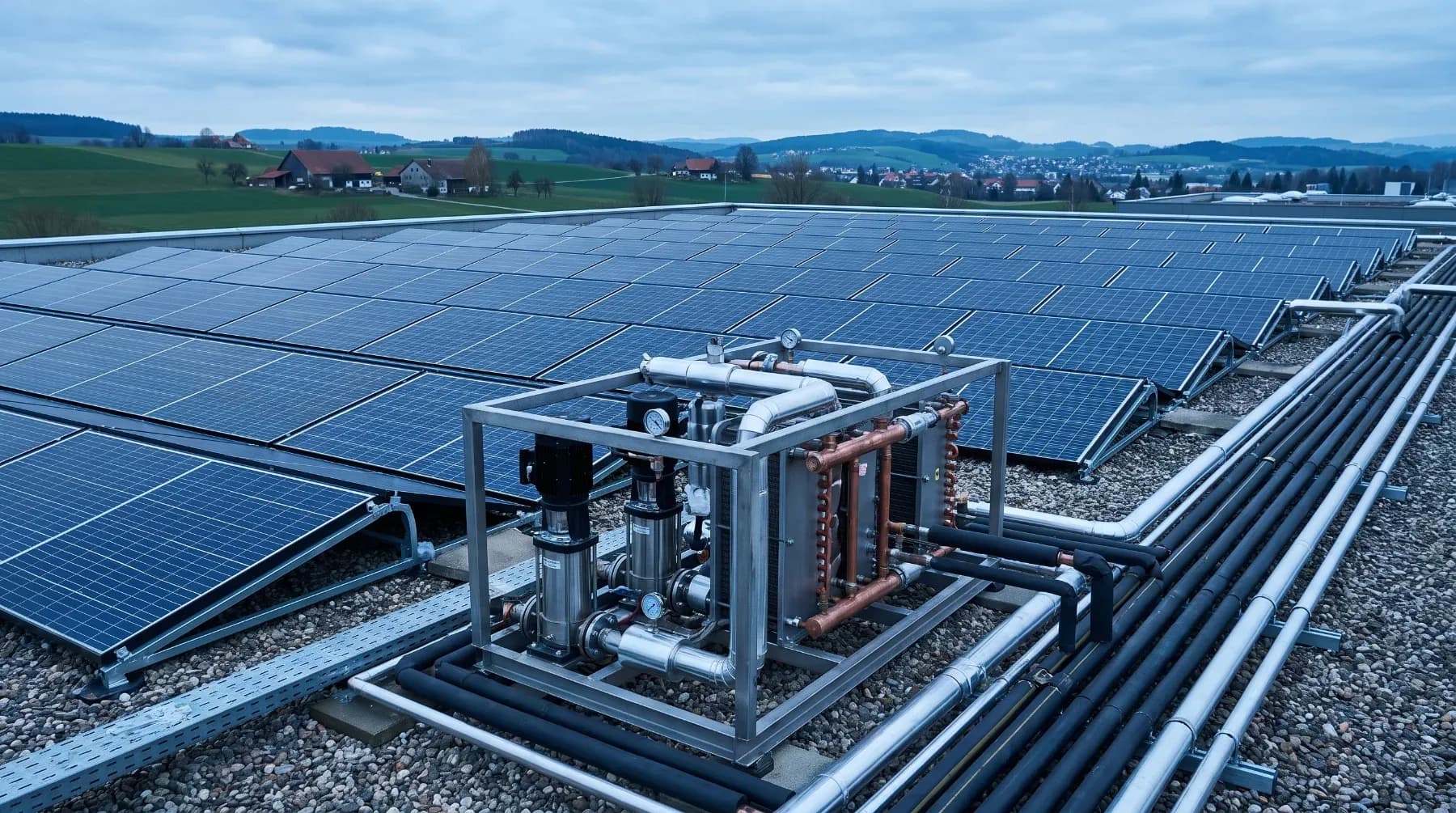
Detailed Scope & Asset Engineering
PVT is not a better solar panel. It is a heat project with an electrical by-product, and it beats conventional PV only under specific conditions. Most of this work is therefore about qualifying the site honestly before anyone commits to the technology.
Where hybrid PVT actually pays
The qualifier is heat demand, not irradiance.
Heat demand decides it. PVT earns its premium where year-round heat demand sits next to the array: district heating substations, hotels and hospitals, food and agri processing, industrial hot water. Without a genuine heat sink, conventional PV is the better investment, and we will say so before you spend money on a feasibility study.
Romania is rebuilding its heat infrastructure. District heating decarbonisation is running on national programmes and EU instruments, and Bucharest has a EUR 200 million geothermal district-heating investment under way. Sites attached to these systems are where solar thermal and PVT can displace gas at a scale that matters, rather than as a demonstration.
Bulgaria: the same question, a different heat map. District heating in Sofia and the larger cities, food processing, greenhouses and hotel complexes are where a thermal collector has something to displace. Elsewhere a straightforward PV plant with storage will beat a hybrid asset, and we will say so.
Co-optimising two energy streams
Collecting electricity and heat from the same surface means the two compete. Extracting heat cools the cell, which helps the electrical side; pushing the fluid loop harder to raise output temperature does the opposite. That trade has to be quantified, not assumed.
- Simultaneous profiles: electrical output mapped against thermal collection hour by hour, so neither stream is optimised at the silent expense of the other.
- Thermodynamic interaction: heat transfer across the module backplate simulated to show exactly how thermal extraction moves cell temperature and open-circuit voltage.
- Exergy, not just efficiency: a second-law account of what the system delivers, because adding a kilowatt-hour of electricity and a kilowatt-hour of low-grade heat and calling it two is not an argument an investor should accept.
Temperature, and the losses it causes
PV efficiency falls as cells heat up. Active cooling is the mechanism by which a PVT array turns that loss into a second product.
- Hot spots and stagnation: uneven fluid distribution across the collector field identified, since a stagnation point damages both the thermal and the electrical side.
- Heat-induced power loss: boundary-layer heat removed to hold cell temperature and voltage stability through the hours when irradiance is highest.
- Smoother injection: a more stable AC profile during high-temperature peaks, which is easier for the network operator to accept and easier for you to forecast.
Hydraulics and balance of plant
A PVT asset lives or dies on its fluid loop. This is the part most often specified by a solar contractor with no thermal background.
- Flow control: variable-speed pumping logic checked against irradiance and storage tank temperature rather than run at a fixed rate.
- Heat exchange and storage: the coupling between array, exchanger and thermal store or district heating loop audited as one system.
- Frost and stagnation: glycol loop protection and high-temperature stagnation behaviour engineered for Central and Eastern European extremes, both ends of the year.
Standards and the electrical connection
- Collector and system standards: collector performance tested to EN ISO 9806, factory-made systems to EN 12976, with the usual IEC certifications on the photovoltaic side.
- Displacement, quantified: the gas or other fuel genuinely displaced, documented in a form that survives a funding or ESG review rather than asserted.
Grid connection: where the plant exports electricity, the national connection rules apply unchanged — the Romanian 2026 auction mechanism and guarantees, or the Bulgarian 10 MW boundary between transmission and distribution. Both are set out on our utility-scale solar page.
What we check before you commit
Simultaneous electrical and thermal yield matched hour by hour against real site heat demand, hydraulic and stagnation behaviour at both seasonal extremes, the fuel volume genuinely displaced, and an honest comparison against separate PV and heat plants on the same site. If the separate plants win, the report says so.
Related work
For the connection the electrical side depends on, see Grid Connection Strategy and Project Development Support. The generation modelling behind the PV half is covered in Yield Assessment.
Consultation Request
Send us the project. The principal engineer reads every request personally.
Segment Details
Sector:Advanced Hybrid PVT Systems
Compliance:Combined electrical and thermal yield verification
Primary Focus:Cooling loop efficiency, the temperature at which cogeneration stops paying, and seasonal yield across both outputs.
Send us a project and we will look at it
Site data, a yield model, a design package or a report you want a second opinion on. We come back with what we would check first — no charge for the first look.
Send a project