
Europe added more battery storage in 2025 than in any year before it, and the pipeline already committed through auctions is three times larger than what was actually built. This is a survey of where that capacity is going, what the systems are made of, how they are configured, and which constraint decides whether a project gets built at all. Every figure below is sourced, and the sources are listed at the end.
The scale, in two numbers
The EU reached 77.3 GWh of cumulative battery storage by the end of 2025, up from 7.8 GWh in 2021. A tenfold increase in four years. To meet its own flexibility needs by 2030, the bloc has to do it again: SolarPower Europe puts the requirement at roughly 750 GWh by the end of the decade.
2025 additions were 27.1 GWh, a 45 percent increase year on year and the twelfth consecutive record. The gap between 77 and 750 is the whole business case for the next five years, and it is the reason grid connection has become the scarce resource rather than equipment.
Utility-scale overtook residential for the first time
The structure of the market changed in 2025. Utility-scale systems delivered 55 percent of all new capacity, roughly 15 GWh of front-of-meter storage in a single year, against 6.5 GWh in 2024. That is more than double in twelve months.
Residential went the other way, falling 6 percent to 9.8 GWh, a second consecutive decline. The drivers were lower electricity prices and the winding down of the emergency support schemes that had pushed home batteries in Germany, Italy and Austria during the energy crisis. Commercial and industrial systems grew modestly and remain the smallest segment.
Where it is being built
The top five EU markets took 63 percent of new installations in 2025: Germany 6.6 GWh, Italy 4.9 GWh, then Bulgaria, the Netherlands and Spain. The concentration is falling, which matters more than the ranking: a year earlier the same five held close to 80 percent. Sweden and Finland crossed 1 GWh between them for the first time, and France and the Netherlands approached gigawatt-hour scale in utility-scale deployment.
Germany is the largest market and the clearest warning. Total installed capacity is around 24 GWh, but large-scale storage accounts for only 3.5 GWh of that; the rest is residential. Meanwhile grid operators have received over 500 GW of connection requests, more than eight times German peak demand. Most of it is speculative queue positioning under first-come-first-served rules.
Outside the EU, the United Kingdom is the most mature utility-scale market in Europe. Operational capacity reached 6,872 MW in 2025, a 509 percent increase since 2020, with close to 10 GW of front-of-meter batteries expected online by the end of 2026 and a Clean Power 2030 target of 23 to 27 GW. The difference is revenue visibility: the UK capacity market gives four to five years of it, which makes projects financeable in a way that pure merchant exposure on the continent does not.
The auction pipeline is three times the build rate
More than 80 GWh of storage was awarded through public tenders across at least ten European countries in 2025 - three times what was installed in the same period, with delivery dates between 2026 and 2030. This is the most reliable forward indicator of where demand for cells, inverters, transformers and EPC capacity will concentrate.
- Poland: 20 GWh through the capacity market, clearing at 465 PLN/kW/year
- United Kingdom: 18 GWh through the capacity market
- Bulgaria: 13.7 GWh through the EU-funded RESTORE programmes, financing 113 projects worth over 1.3 billion dollars
- Italy: 10 GWh tendered
- Lithuania 4 GWh, Belgium 2.8 GWh, Germany and Greece 750 MWh each, Portugal 500 MW across 43 projects
Spain is still waiting on European Commission approval of its capacity mechanism, which is why it appears in the installation table but not in the auction table.
Romania and Bulgaria, in detail
These are the two markets we work in, so the numbers are worth stating precisely rather than as a regional average.
Romania had close to 600 MW of installed battery storage at the end of 2025. As of 1 June 2026, ANRE data showed 143 storage projects totalling 9,147 MW in advanced development, of which 36 projects and 2,050 MW were scheduled to enter operation during 2026. The pipeline is therefore more than fifteen times the installed base.
The reason capital is moving is arbitrage, not policy. An ENTSO-E study put average daily earnings for Romanian storage at EUR 792 per MW of installed capacity, fourth in Europe behind Hungary at 800, Bulgaria at 798 and Greece at 797. All four sit in South-Eastern Europe, and the common cause is weak interconnection with the cheaper markets of Central Europe. Solar depresses prices during the day, imports set the price in the evening peak, and the spread between the two is the revenue.
Bulgaria reached roughly 2,500 MWh of installed storage by the end of 2025 and is one of the top five EU markets by new capacity, largely on the back of the RESTORE grants. For a country of its size, that is the most aggressive storage build in the union.
One number puts the Romanian grid constraint in perspective: 1,530 renewable projects with a combined approved evacuation capacity of 91,118 MW are currently in the connection process, while operators expect 647 projects totalling 30,366 MW to actually be commissioned between 2026 and 2035. The queue is roughly three times what the network expects to connect.
What these systems are actually made of
Stationary storage has converged on lithium iron phosphate. LFP gives up energy density against nickel-based chemistries and gains cycle life, thermal stability and cost, which is the right trade when the asset sits on the ground and cycles daily for fifteen years rather than moving.
Europe has built a cell industry, but not for this market. EU nominal cell production capacity reached 252 GWh in 2025, and over 90 percent of it is geared toward electric vehicles, with roughly 70 percent using nickel-based chemistries. Poland leads at 86 GWh per year, then Hungary at 78, France at 42 and Germany at 40. The result is a mismatch: the continent manufactures cells at scale and still imports the chemistry its storage market actually buys. Cathode and anode active material production remains the weakest link in the chain, with electrolyte and separator supply in better shape.
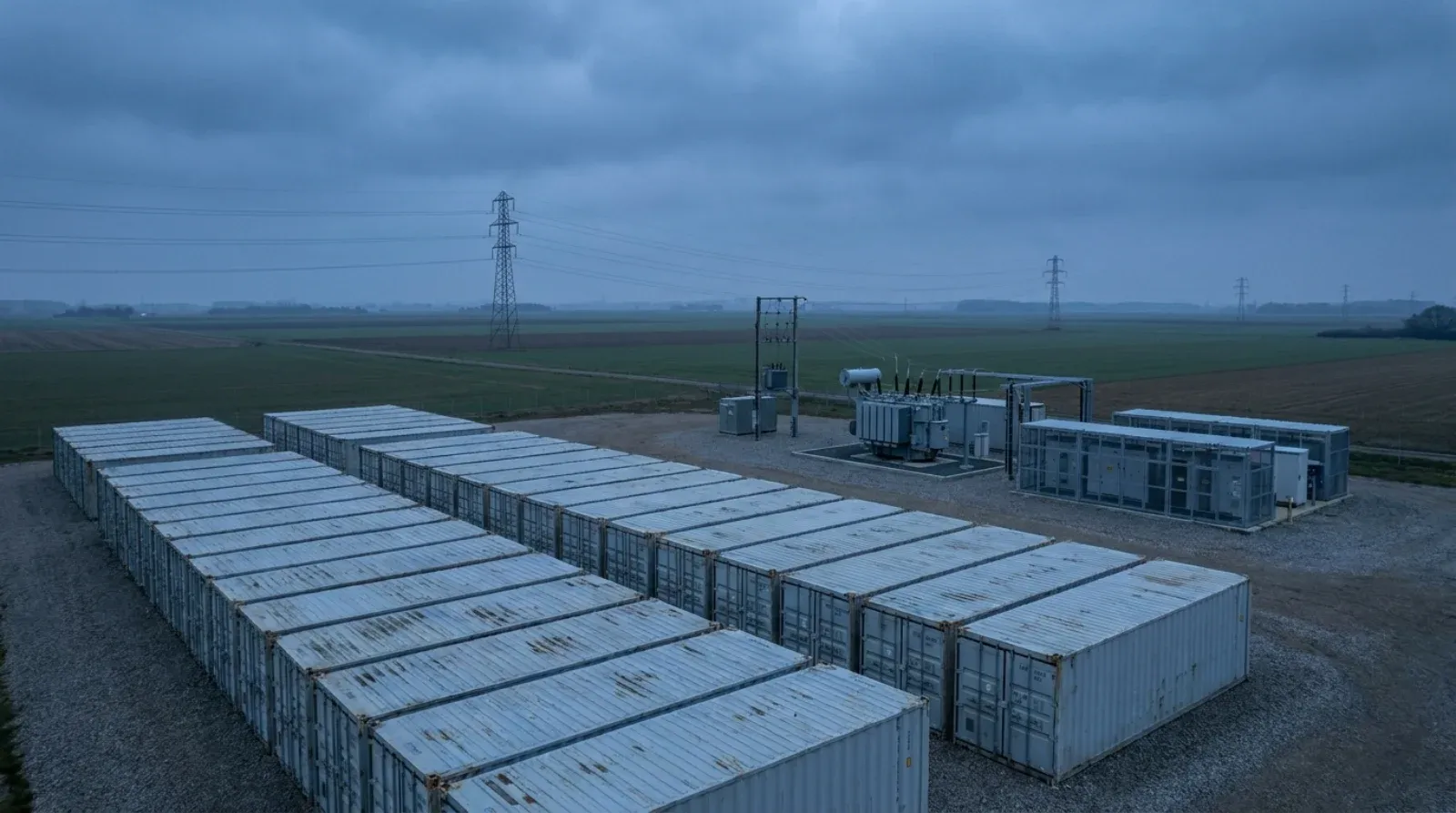
At system level, the market has standardised around containerised units. A modern utility-scale block is a 20-foot enclosure in the 5 MWh class, liquid-cooled, with integrated fire detection and suppression, delivered pre-assembled and connected to a separate power conversion system and medium-voltage transformer skid. This is why project schedules are now set by grid works and civil works rather than by battery delivery.
Pack prices fell to 70 dollars per kWh in 2025, a 45 percent drop in a single year, making stationary storage the cheapest lithium-ion segment for the first time. The technology is no longer the barrier.
How they are configured
Duration follows the revenue stack, and the projects being built now show the split clearly. Two-hour systems dominate where the money comes from arbitrage and ancillary services, which is most of continental Europe today. Four-hour systems appear where capacity payments or long-duration schemes reward holding energy longer.
The largest projects illustrate both ends. LEAG and Fluence are building Europe's largest system at Jaenschwalde in Germany at 1 GW and 4 GWh, a four-hour configuration announced in November 2025. In the UK, Carlton Power's Trafford project in Manchester is 1,040 MW, and Matrix Renewables signed a full EPC agreement with Tesla for a 500 MW and 1 GWh Megapack installation at Eccles, a two-hour configuration that has cleared planning and is ready for construction.
The engineering consequence of that choice is not only battery quantity. Duration sets the C-rate the cells run at, which sets thermal load, which sets the cooling design and, through it, the degradation curve and the warranty conditions. A two-hour system and a four-hour system of the same power are different machines, not the same machine with more boxes.
The binding constraint is the connection, not the battery
This is the practical conclusion of everything above. Equipment cost has fallen 45 percent in a year and standardised into containers. Cell supply is tight on chemistry but not on volume. What decides whether a project exists is a grid connection: 500 GW of speculative requests in Germany, 91 GW in the Romanian queue against 30 GW expected to connect.
Regulators have responded by making queue positions expensive. Romania raised the financial guarantee for issuing a connection permit from 5 to 20 percent of the connection tariff in May 2026, added a guarantee of 20,000 euro per MW to enter a capacity allocation auction, and 30 euro per kW when applying for the establishment authorisation. Germany has promised its own connection reform package. The direction is the same everywhere: capital is committed earlier, and requesting more capacity than you intend to build is now a real cost rather than a free option.
Revenue compression is already visible
Anyone modelling a project on today's spreads should look at what happened in Germany during 2025. The arbitrage spread for a two-hour system averaged 140 euro per MWh in summer and fell to 79 euro per MWh by the fourth quarter, according to S&P Global Platts. That is a 44 percent compression inside two quarters, driven by storage capacity itself arriving on the system.
The same mechanism will reach South-Eastern Europe. The 792 euro per MW per day that makes Romania attractive today exists because storage is scarce there and interconnection is weak. Adding 2 GW in one year changes the first condition. A financial model built on the current spread, held flat for fifteen years, is not a forecast - it is an assumption, and it should be labelled as one.
Regulation arriving between now and 2027
Three instruments will change how storage is bought, not just how it is built.
- EU Battery Regulation: carbon footprint declarations required for industrial batteries from 2025, and a full electronic battery passport covering origin, chemistry, carbon intensity and recycling from February 2027
- Net-Zero Industry Act: implemented by member states from 2026, requiring at least 30 percent of auctioned capacity to be assessed on non-price criteria such as sustainability and supply chain resilience
- Critical Raw Materials Act: due diligence guidelines expected by August 2026
The practical effect is that price per kWh stops being the only variable in a tender. Carbon footprint, material provenance and recyclability become eligibility conditions. A supplier who cannot produce a battery passport in 2027 is not a cheaper supplier, but an ineligible one.
What we check before capital is committed
Our work sits at the point where these numbers meet a specific site, so this is the short version of what we look at:
- Whether the requested connection capacity matches what the node can physically take, before a guarantee is posted against it
- Whether the duration chosen matches the revenue the model actually assumes, and what the C-rate does to degradation at that duration
- Whether the UL 9540A report covers the product and arrangement being installed, or a related one from the same vendor
- Whether the warranty is written against the cycling regime, temperature range and state-of-charge policy the site will really operate under
- Whether the revenue assumption is a spread observed today or a spread held flat for the life of the asset
None of this is exotic. It is the difference between a model that survives a lender's reviewer and one that does not.
Sources
- SolarPower Europe, EU Battery Storage Market Review 2025, press release of 28 January 2026
- S&P Global Commodity Insights, European storage outlook and Platts spread data, 2025 and 2026
- Wood Mackenzie, European battery storage deployment and German connection queue analysis
- ANRE data on Romanian storage projects as of 1 June 2026, via Cursdeguvernare and Romania Insider, July 2026
- ENTSO-E study on battery storage revenue by market
- ANRE press release of 21 May 2026 on the amended connection and licensing regulations
- Fluence and LEAG announcement on the Jaenschwalde project, November 2025; Matrix Renewables announcement on the Eccles project