
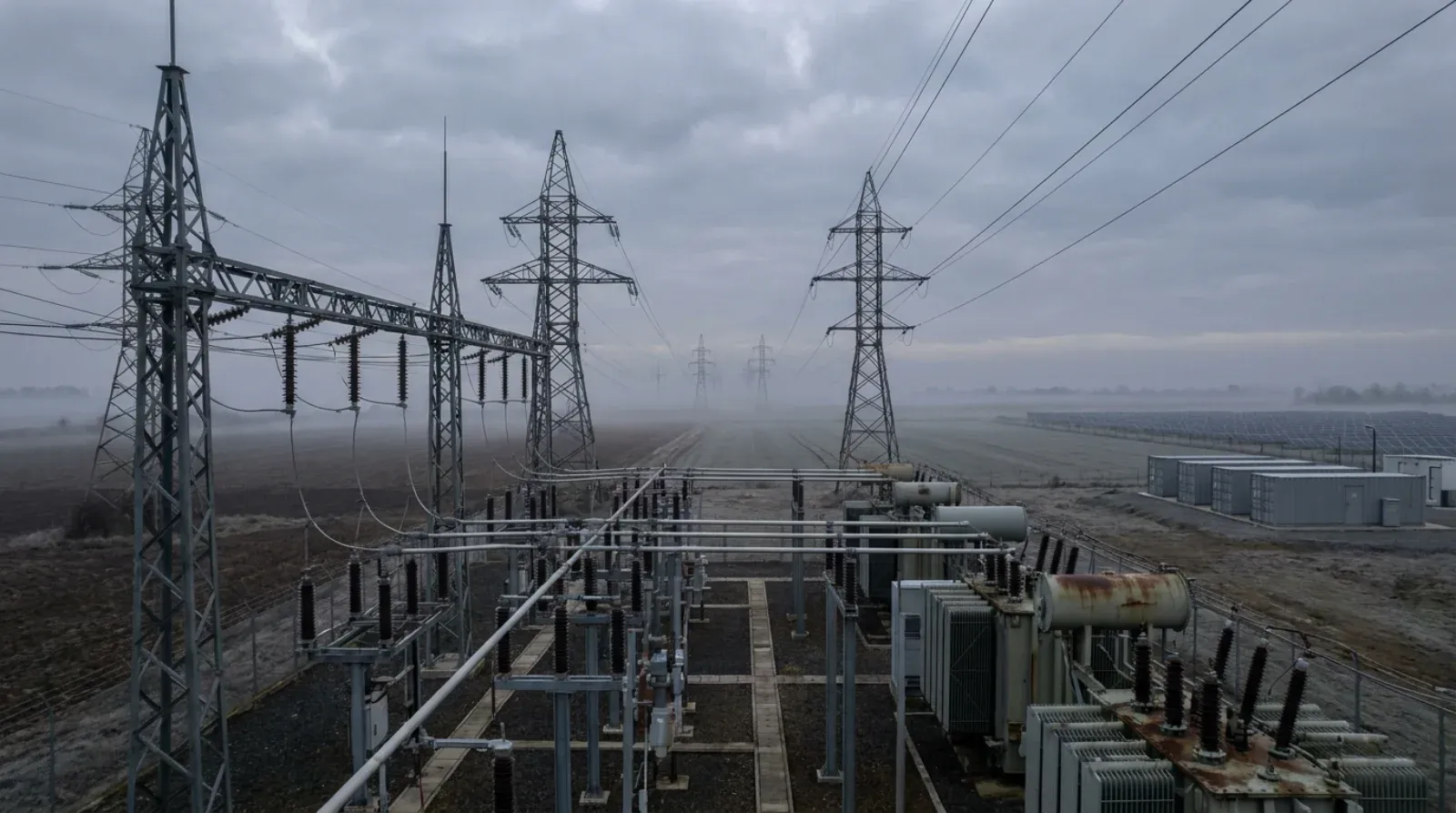
Two neighbouring markets, two different procedures, and the same underlying question: what does it cost to hold a place in the queue, and what does the asset earn once it is connected. This is the practical version of grid access in Romania and Bulgaria as the rules stand in August 2026, with the money named at each step.
Grid access stopped being paperwork and became capital
Until recently a connection request in South-Eastern Europe was cheap to make and expensive to abandon only for the network operator. Both countries have now inverted that. Romania raised its guarantees in May 2026 and put deadlines on the authorisation stage. Bulgaria attached a deposit to the operator's connection opinion. The direction is identical: a request for capacity you do not intend to build now costs real money on the day you make it.
That matters more than the tariff itself. The technology is settled and equipment prices fell 45 percent in a single year. What decides whether a project exists is whether it can hold a viable connection point long enough to be built, and whether the developer can carry the deposits while it does.
Romania: the path, step by step
The framework is ANRE Order 59/2013 with subsequent amendments, most recently Order 15/2026. The sequence is fixed and worth knowing precisely, because the deadlines now run against you.
- Application to the network operator, with the site, the requested evacuation capacity and supporting documents
- Technical connection permit, the ATR, which the operator must issue within 30 calendar days of receiving a complete file
- Connection contract, at which point the clock on the establishment authorisation begins
- Establishment authorisation from ANRE, which must be obtained within 12 months of the connection contract and 18 months of the ATR
- Connection works, whose duration sits in the connection contract; since May 2026 the operator may request successive 12-month extensions for the works that are its own responsibility
The extension on the authorisation stage exists but is narrow: once, for a maximum of 12 months, and only for reasons that are documented and not attributable to the applicant. Losing the deadline means losing the position.
Romania: what each step costs
Two costs are routinely confused, and the difference between them is three orders of magnitude.
- The fee for issuing the ATR is administrative: 70 lei up to 30 kVA, 160 lei for 30 to 100 kVA, 215 lei above, and around 350 lei in practice for projects in the 50 to 100 MW range, all excluding VAT
- The connection tariff is the real number, calculated by the operator only after the ATR is issued. For parks of 1 to 10 MW the market sits between 30 and 120 EUR per kW installed, and in cases requiring a new evacuation line the connection can reach 20 to 25 percent of total capex
On top of that sit the guarantees introduced in May 2026:
- 20 percent of the connection tariff excluding VAT, up from 5 percent, for issuing the ATR on projects above 1 MW of approved evacuation capacity
- 20,000 EUR per MW of requested capacity to enter a capacity allocation auction, payable when the request is filed rather than later
- 30 EUR per kW of installed capacity when applying for the establishment authorisation, held until the works reception protocol and executed if the project is not completed in time or is abandoned
For a 50 MW project that is one million euro to enter the auction and 1.5 million for the authorisation, before the connection tariff and before any equipment. The regulator was explicit that this is a selection instrument rather than a penalty: the 5 percent guarantee introduced in 2024 had failed to filter out projects reserving capacity with no intention to build.
Bulgaria: a different structure for the same problem
Bulgaria rebuilt its connection rules with Ordinance No. 6 of the Energy and Water Regulatory Commission, adopted on 28 March 2024 and in force from 2 April 2024. It set out, for the first time, a dedicated procedure for storage facilities rather than treating them as generation.
The storage route has three stages, and each is a separate document rather than a milestone inside one contract:
- An opinion from the network operator, valid for one year
- A preliminary grid connection agreement, with its own validity term
- A final grid connection agreement, which under the ordinance no longer carries a fixed validity limit, where the previous regime capped it at three years
Which operator you deal with depends on size. Projects up to and including 1 MW go to the territorially competent distribution operator; above 1 MW the applicant chooses an operator in the relevant territory. For renewable generation the threshold for connecting to the transmission operator ESO moved from 5 MW to above 10 MW, with everything up to 10 MW on the distribution grids.
One provision saves a great deal of time and is easy to miss: no connection procedure is required at all where a storage facility is built at an existing or new site without changing the connected capacity of the production or consumption point. Co-locating storage inside an existing connection is procedurally a different animal from asking for new capacity.
Bulgaria also moved the starting gate earlier for renewables. A developer can now open the procedure on the basis of in rem rights over the land, where previously a design visa or an approved detailed development plan was required. That lets the preliminary agreement be secured while zoning runs — though in practice the two-year validity of that agreement is often not enough to finish zoning and environmental procedures for wind.
Bulgaria: the deposit
The financial filter sits at a different point in the process than in Romania. Storage investors must provide a deposit or bank guarantee of BGN 50,000 per MWh of capacity to be connected, roughly 25,600 euro per MWh at the fixed lev rate. It is due upon receipt of the operator's opinion on the connection request, with a three-month deadline from the date the opinion is issued. If the investor never applies for a preliminary connection contract, the operator deducts from the guarantee the costs it incurred securing system access for the site.
Note the unit. Romania charges against power and against the connection tariff; Bulgaria charges against energy. For a 50 MW two-hour system, 100 MWh, the Bulgarian deposit is on the order of 2.5 million euro. For a four-hour system of the same power it doubles. Duration is not only an engineering choice in Bulgaria — it is a cash flow decision at the connection stage.
Where the two regimes actually differ
- Romania front-loads money at the auction and the authorisation; Bulgaria front-loads it at the operator's opinion
- Romania runs deadlines against the developer with one narrow extension; Bulgaria relies on validity terms per document, and has removed the fixed limit on the final agreement
- Romania scales the guarantee to the connection tariff and to power; Bulgaria scales it to energy, which penalises long-duration systems
- Bulgaria exempts storage added inside an existing connection from the procedure entirely; in Romania a change in installed capacity flows through an updated ATR, and for hybrid or retechnologisation projects the guarantee is calculated on the increase in capacity
What the asset earns on the other side
The reason capital tolerates these deposits is that South-Eastern Europe currently pays more for storage than anywhere else on the continent. An ENTSO-E study put average daily earnings at 800 euro per MW of installed capacity in Hungary, 798 in Bulgaria, 797 in Greece and 792 in Romania — the four highest in Europe.
The cause is structural rather than clever market design. Interconnection between South-Eastern Europe and the cheaper markets of Central Europe is weak. Solar output depresses wholesale prices through the middle of the day; in the evening peak, limited local flexibility and reliance on imports set a much higher price. The spread between those two states of the same day is the revenue, and weak interconnection is what stops it from being arbitraged away by neighbours.
That is a real advantage and it is also a warning label. The number exists because storage is scarce and the borders are thin. Both conditions are being actively removed.
How fast the advantage is being consumed
Romania ended 2025 with close to 600 MW of installed storage. As of 1 June 2026 ANRE data showed 143 projects totalling 9,147 MW in advanced development, of which 36 projects and 2,050 MW were scheduled to enter operation during 2026. That is more than a tripling of the installed base inside one year, from a pipeline fifteen times its size.
Bulgaria reached roughly 2,500 MWh by the end of 2025 and is among the top five EU markets by new capacity, on the back of the EU-funded RESTORE programmes: 13.7 GWh allocated across 113 projects worth over 1.3 billion dollars, with contracts reported for around 6,000 MWh under the tender programme.
Germany shows what happens next. The arbitrage spread for a two-hour system there averaged 140 euro per MWh in summer 2025 and fell to 79 euro per MWh by the fourth quarter, a 44 percent compression inside two quarters, driven by storage capacity itself arriving on the system. There is no mechanism that exempts Bucharest or Sofia from the same arithmetic.
The practical consequence for a financial model: a spread observed in 2026 and held flat for fifteen years is not a forecast. It is an assumption, and it belongs in the assumptions register where a lender's reviewer can argue with it, not buried in a revenue line.
Reading the two queues honestly
Romania has 1,530 renewable projects with a combined approved evacuation capacity of 91,118 MW in the connection process, while operators expect 647 projects totalling 30,366 MW to actually be commissioned between 2026 and 2035. The queue is roughly three times what the network expects to connect. A position in that queue is not the same thing as a project.
This is exactly what the new guarantees are designed to thin out, and it is why the choice of connection point matters more than the choice of supplier. A node that clears with modest reinforcement and a node that requires a new line can differ by 20 percent of total capex — and that difference is decided before a single container is ordered.
What we check before a guarantee is posted
- Whether the requested capacity is what the node can physically absorb, and what the alternatives twelve kilometres away would have cost in reinforcement
- Whether the duration chosen is right for the revenue assumed, and in Bulgaria what that duration does to the deposit, since it scales with energy
- Whether the file is complete in the sense the operator means, because the 30-day Romanian deadline runs from a complete file and not from the first submission
- Whether the project can realistically reach the establishment authorisation inside 12 and 18 months, given zoning and environmental timelines
- Whether the revenue case survives a spread at half of today's level, which is what Germany delivered in two quarters
None of this replaces a local attested designer, and we do not sign Romanian design documentation. What we do is the engineering reasoning behind the request, before the money is committed against it.
Sources
- ANRE press release of 21 May 2026 on the amended connection and licensing regulations; Orders 15/2026 and 16/2026
- ANRE Order 59/2013, Regulation on the connection of users to public interest electricity networks, as amended
- ANRE data on Romanian storage projects as of 1 June 2026, via Cursdeguvernare and Romania Insider, July 2026
- KEVR Ordinance No. 6 of 28 March 2024 on the connection of energy sites to the grids, in force 2 April 2024; CMS legal update
- KEVR decision on deposits and bank guarantees for electricity storage investors, reported by ess-news and Balkan Green Energy News
- ENTSO-E study on battery storage revenue by market
- SolarPower Europe, EU Battery Storage Market Review 2025; S&P Global Platts spread data