
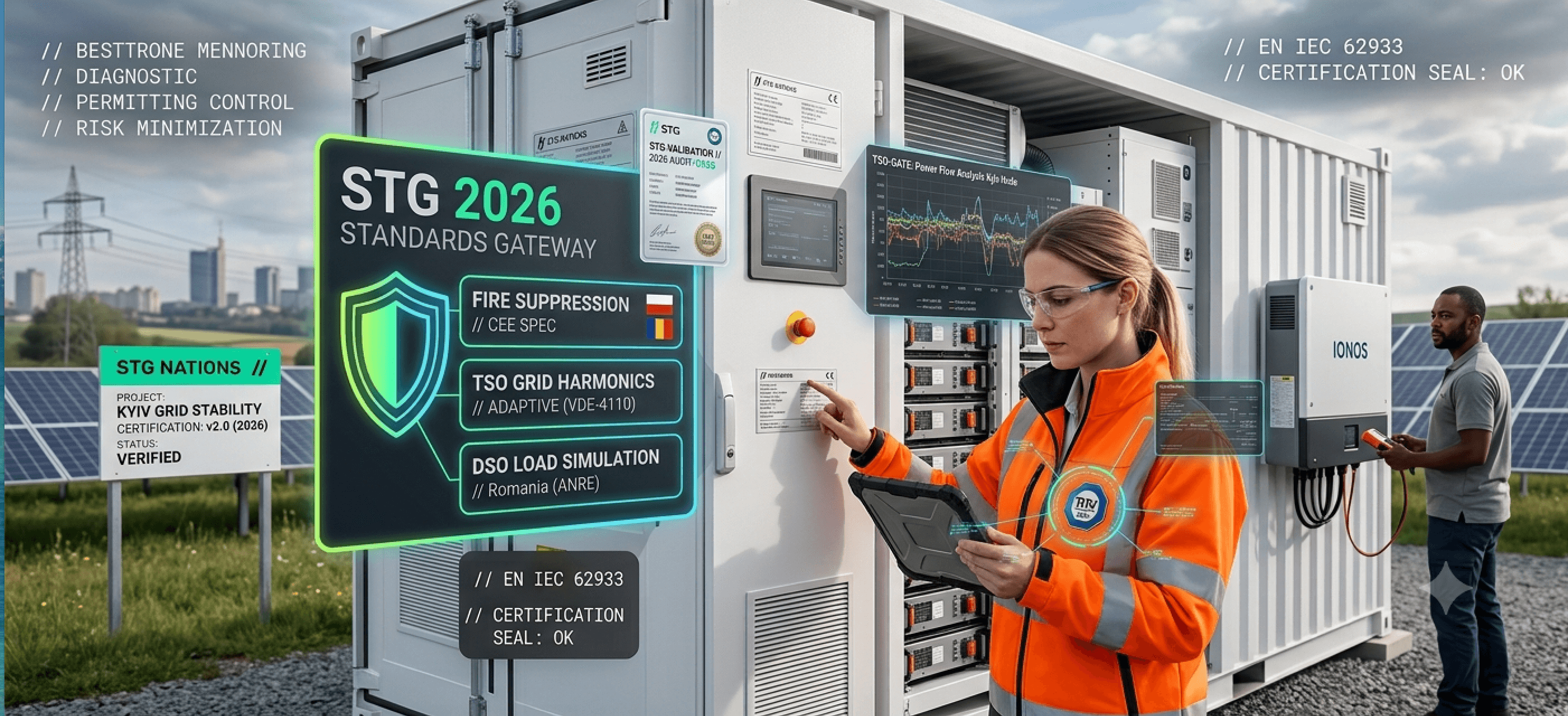
BESS Safety Standards in Europe: What the 2025 Updates Mean for Project Permitting
Battery Energy Storage Systems above a certain threshold require fire safety assessment, hazardous area classification, and — in most European jurisdictions — formal approval from the local fire authority before commissioning. The specific requirements vary by country, but the direction of regulatory travel is consistent: standards are tightening, and the approval process is getting longer.
For projects currently in development or approaching commissioning, understanding where the standards changed in 2025 is directly relevant to timeline and cost planning.
The EN IEC 62933 series — what changed
The EN IEC 62933 series governs electrical energy storage systems including BESS. Part 5-2, covering safety requirements for grid-connected systems, was updated in 2024 and is being adopted across Member States throughout 2025 and 2026.
The key changes for utility-scale BESS:
Prescriptive Thermal Runaway Detection: The updated standard introduces more prescriptive requirements for thermal runaway detection and suppression. Previous editions allowed a range of approaches to early detection. The 2024 update specifies minimum performance criteria for gas detection systems — specifically hydrogen and carbon monoxide — as early indicators of cell degradation before thermal runaway occurs.
Increased Separation Distances: Separation distances between battery modules and between battery containers have been revised upward in the fire safety annexes. Projects designed to previous separation standards may require layout modifications to achieve compliance, particularly those using high-energy-density lithium iron phosphate (LFP) configurations.
Extended Testing Metrics: Testing documentation requirements have been extended. Suppliers must now provide third-party test reports for the complete battery system as installed — not just the cell chemistry — including fire propagation tests and short-circuit tests at the system level.
Country-specific requirements that go beyond the EN IEC standard
Germany: The Technische Regeln für Betriebssicherheit (TRBS) apply to BESS installations classified as pressure equipment or hazardous installations. Projects above 1 MWh require a Gefährdungsbeurteilung — a formal hazard assessment — filed with the relevant Berufsgenossenschaft.
Spain: The Reglamento de Seguridad Contra Incendios en los Establecimientos Industriales (RSCIEI) classifies BESS installations by fire load. Projects above 3 MWh typically require a formal fire protection project approved by the Consejería competente in the relevant autonomous community.
Italy: The Vigili del Fuoco have issued guidance stating that BESS projects above 1 MWh require a Certificato di Prevenzione Incendi (CPI) — fire prevention certificate — with inspection and sign-off before grid connection.
What this means for your project timeline
Fire authority approvals in Germany, Spain, and Italy are adding four to eight weeks to commissioning timelines compared to 2023, based on engagements STG Nations has supported over the past 12 months. In some jurisdictions, the approval queue for BESS projects is running longer than the approval queue for the solar component of the same hybrid project.
Projects currently targeting Q3 or Q4 2026 commissioning should verify that fire safety submissions are already in progress with the relevant local authority.
The technical documentation package
A compliant BESS safety submission requires: System-level fire test reports from an accredited laboratory, a site-specific fire risk assessment, a thermal runaway management plan, and — for projects in Germany — a full hazard assessment under TRBS 1111.
STG Nations prepares and reviews BESS safety documentation packages for projects across Europe. We work directly with fire authorities in Spain, Germany, Italy, Romania, and Poland.