
Thermal Runaway in Utility-Scale BESS: What the Incident Data Actually Shows
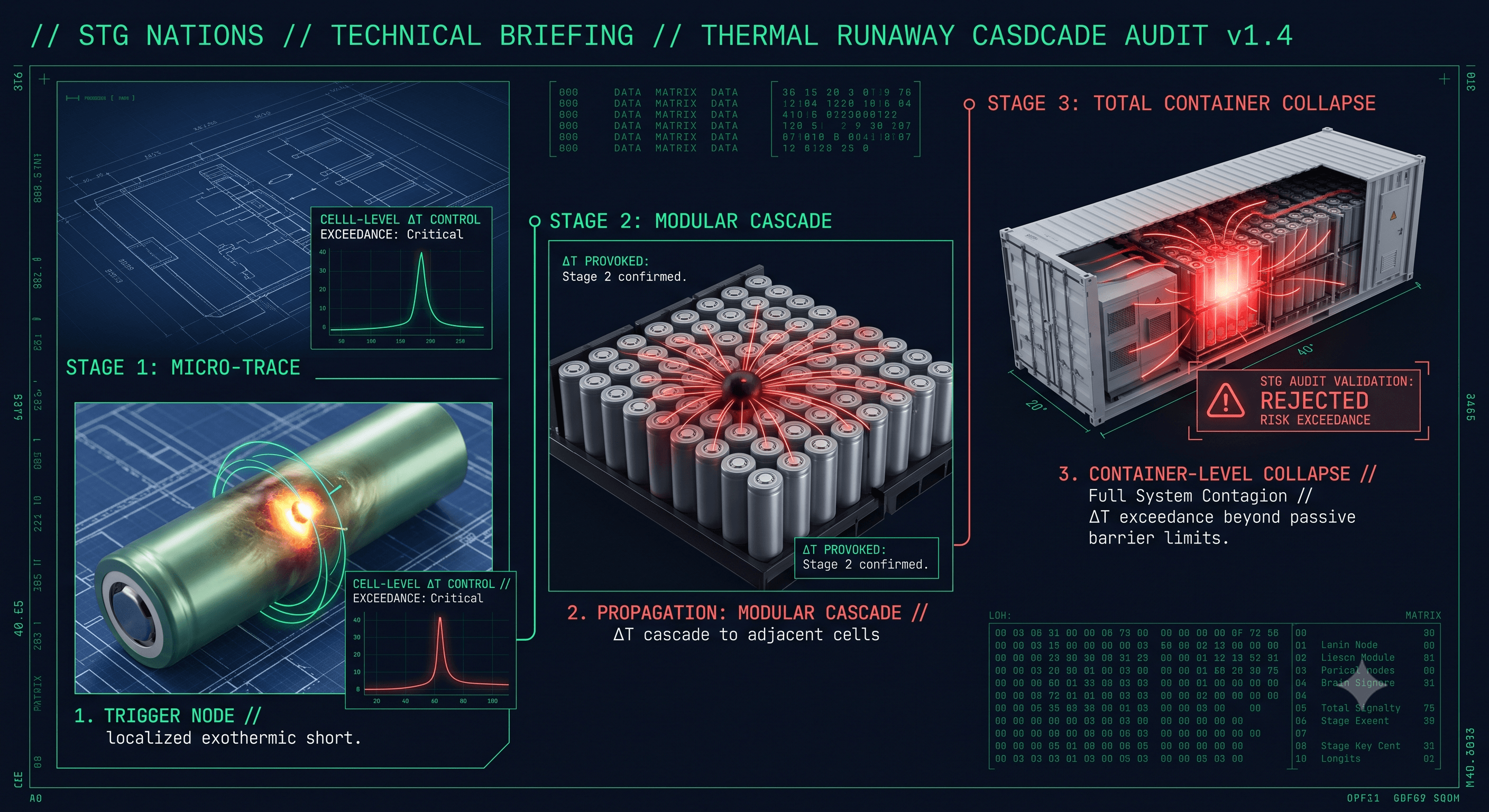
Thermal runaway is the primary safety risk in lithium-ion battery storage systems. It occurs when a cell enters an uncontrolled exothermic reaction — heat generated by the reaction raises temperature faster than the system can dissipate it, which triggers adjacent cells, propagating through the module, and in worst cases, through the entire battery container.
The question that matters for project developers and investors is not whether thermal runaway can happen — it can, and it does — but what the incident data shows about where and why it occurs, and what engineering controls reduce the probability.
What the incident data shows
The European Network of Transmission System Operators for Electricity (ENTSO-E) and national fire authorities in Germany, Spain, and the UK have published incident summaries covering utility-scale BESS events between 2020 and 2025.
The pattern across these reports is consistent. The majority of thermal runaway incidents at utility scale were preceded by one of three conditions: A manufacturing defect in a cell that escaped quality control, an electrical fault — most commonly a connector failure or DC arc — that caused localised heating, or inadequate monitoring that allowed a single degraded cell to reach critical temperature without triggering an alarm.
Projects with active cell-level monitoring, gas detection, and arc fault detection interrupted the sequence before propagation in cases where those systems functioned correctly. Projects without those systems, or with systems that were not commissioned properly, experienced full container events.
The three engineering controls that matter most
Early detection: Gas detection — specifically hydrogen and carbon monoxide sensors at the cell and module level — provides earlier warning than temperature sensors alone. A cell can begin off-gassing hydrogen 20 to 40 minutes before reaching thermal runaway temperature. Twenty minutes is enough time to isolate the affected module and prevent propagation if the detection system is integrated with the BMS and the site alarm protocol is correctly configured.
Electrical protection: DC arc faults are the second most common initiating cause in the incident dataset. Arc fault detection at the string and module level, combined with correctly specified DC disconnects and cable management, addresses the majority of electrical initiation scenarios.
Commissioning verification: A significant proportion of incidents in the dataset occurred within the first six months of operation — the period when commissioning deficiencies manifest. Independent commissioning support, including witnessed functional tests of all safety systems before energisation, is the single most effective control for early-life incidents.
What this means for design and procurement
At the procurement stage, the choice of battery management system (BMS) architecture and the specification of monitoring and detection systems is more consequential than the choice of cell chemistry for safety outcomes. Two projects using the same LFP cells but different BMS and detection configurations have materially different risk profiles.
At the construction stage, the commissioning protocol for safety systems — gas detection calibration, arc fault detector testing, BMS alarm threshold verification — requires independent oversight, not just contractor sign-off.
STG Nations provides independent commissioning support for BESS projects across Europe, including witnessed functional testing of all safety-critical systems before grid connection.