
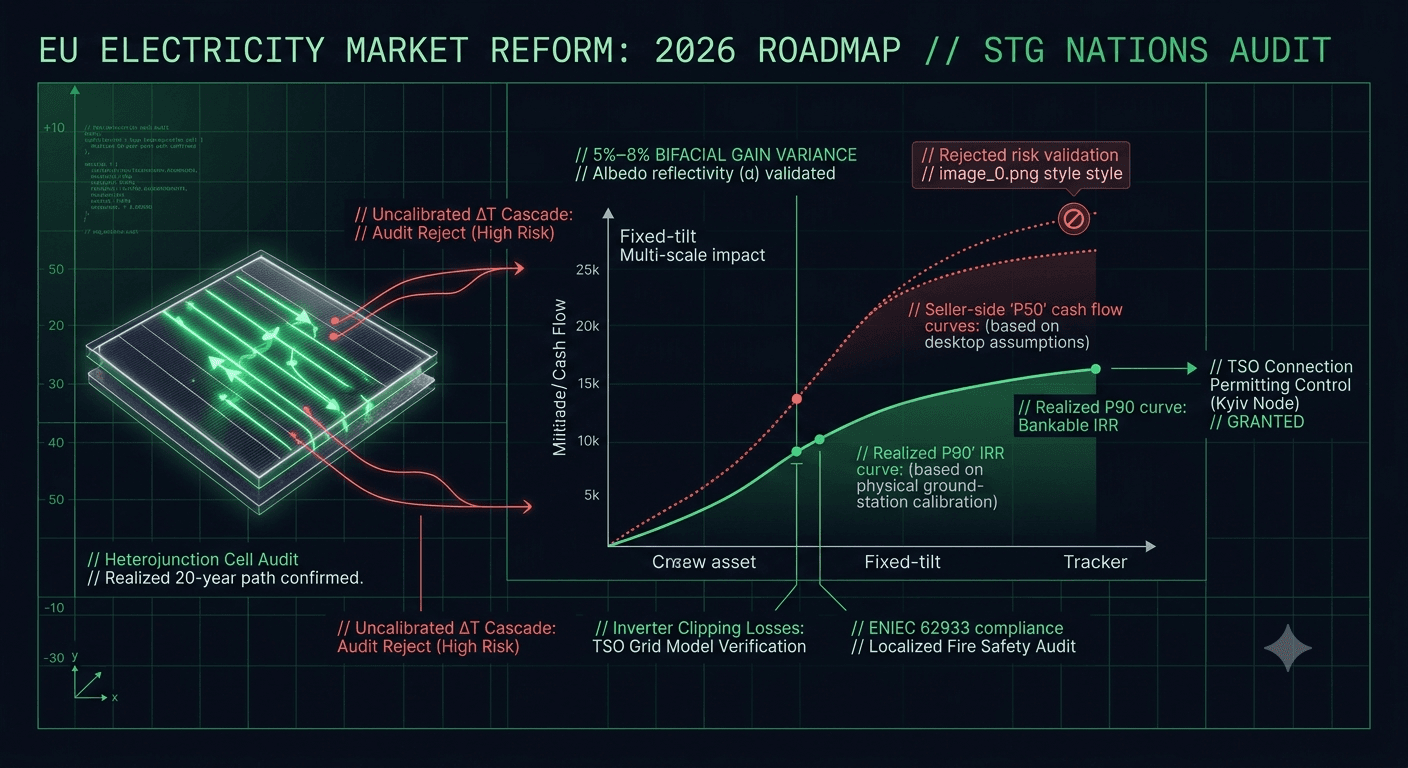
EU Electricity Market Reform: What Changes for Solar Developers in 2026
The revised EU Electricity Market Design Regulation came into force in mid-2024. Eighteen months later, its practical impact on utility-scale solar development is becoming visible in project pipelines across Spain, Germany, Italy, and Poland.
Three changes matter most for developers and investors currently in permitting or financial close.
Power Purchase Agreements and merchant risk
The reform gives Member States clearer authority to require two-way Contracts for Difference (CfDs) for projects receiving public support. In practice, this means projects in Spain and Italy that tap into national auction schemes are now subject to revenue caps during high-price periods. For merchant projects — those outside auction frameworks — the reform leaves PPAs as the primary bankability instrument.
Lenders are responding by tightening PPA counterparty requirements. Investment-grade offtakers or sovereign guarantees are now standard conditions in project finance term sheets across northwestern Europe.
Grid priority for renewables
Article 20a of the revised directive requires Member States to grant priority dispatch to renewable generation below 400 kW and to maintain it for larger projects where grid stability permits. Several transmission operators — including RTE in France and REE in Spain — have updated their grid connection procedures to reflect this, though implementation timelines vary by country.
For projects currently in grid connection queues, this creates both opportunity and complexity. Priority dispatch is not automatic above 400 kW — it requires a technical assessment, and that assessment adds time and cost to the connection process.
Flexibility services and BESS integration
The reform explicitly recognises battery storage as a flexibility resource, not a generation asset, in several Member States for the first time. This distinction matters for permitting, grid tariffs, and revenue stacking strategies.
Projects combining solar and BESS can now pursue capacity market revenues, balancing services, and energy arbitrage simultaneously in markets where the regulatory framework has been updated — currently Germany, France, and the UK, with Spain expected to follow in late 2026.
What this means for your project
Regulatory frameworks are evolving faster than most project timelines. A grid connection strategy that was bankable in 2023 may require revision today. Energy yield assumptions built before the reform may not reflect current dispatch rules.
STG Nations monitors regulatory developments across all major European markets. If your project is in development or approaching financial close, an independent technical review can identify where regulatory changes affect your assumptions.