
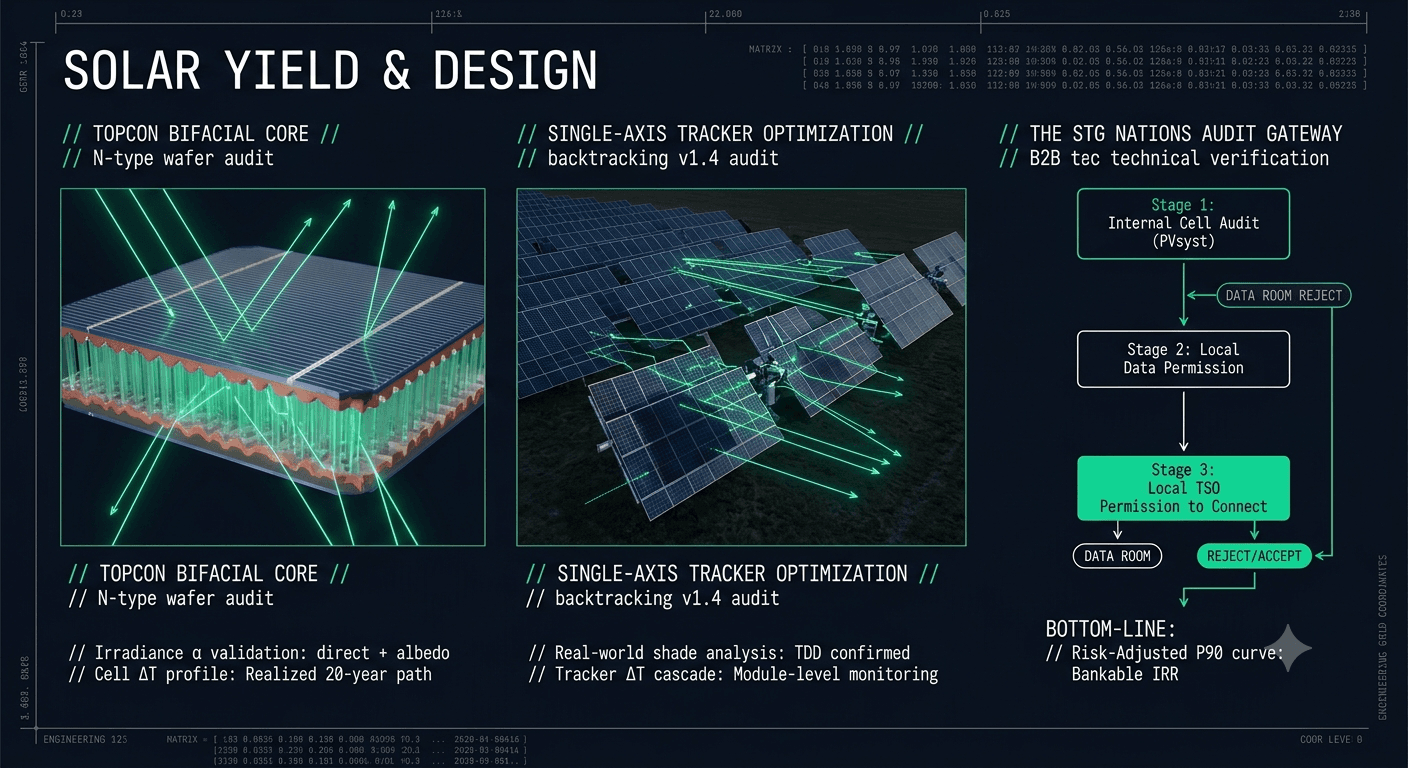
Solar Yield Assessment: Why the P50 Figure in Your Data Room Is Not What You Think
The P50 energy yield estimate is the central number in any solar investment case. It drives the revenue line in the financial model, the debt service calculation, and ultimately the equity return. It is also the figure most likely to be wrong.
Not because yield consultants are careless. Because the methodology behind a P50 estimate involves more assumptions than most investment teams realise — and those assumptions are made by someone working for the seller.
What a P50 estimate actually measures
P50 means there is a 50% probability the plant will produce at least that much energy in any given year. It is not a guaranteed output figure. It is a statistical estimate based on historical irradiance data, modelled losses, and equipment performance assumptions.
Each of those inputs contains uncertainty. The irradiance dataset might cover 10 years of satellite data from a station 20 kilometres from the site. The soiling losses might be modelled at 1% per year based on regional averages rather than site-specific dust or rainfall patterns. The inverter efficiency curve might use manufacturer datasheet values rather than field-measured performance.
Individually, each assumption is defensible. Cumulatively, they can produce a P50 estimate that is 8 to 12% above what the plant actually delivers.
The three inputs most often overstated
Irradiance data source: High-quality yield assessments use at least two independent irradiance datasets — satellite and ground-based — and cross-validate them. Single-source assessments using only satellite data carry higher uncertainty, particularly in regions with complex topography or high aerosol loading.
Horizon and shading analysis: Near-shading from structures, vegetation, or terrain features is frequently underestimated in desktop studies. A site visit with horizon measurements resolves this. Many seller-side assessments do not include one.