
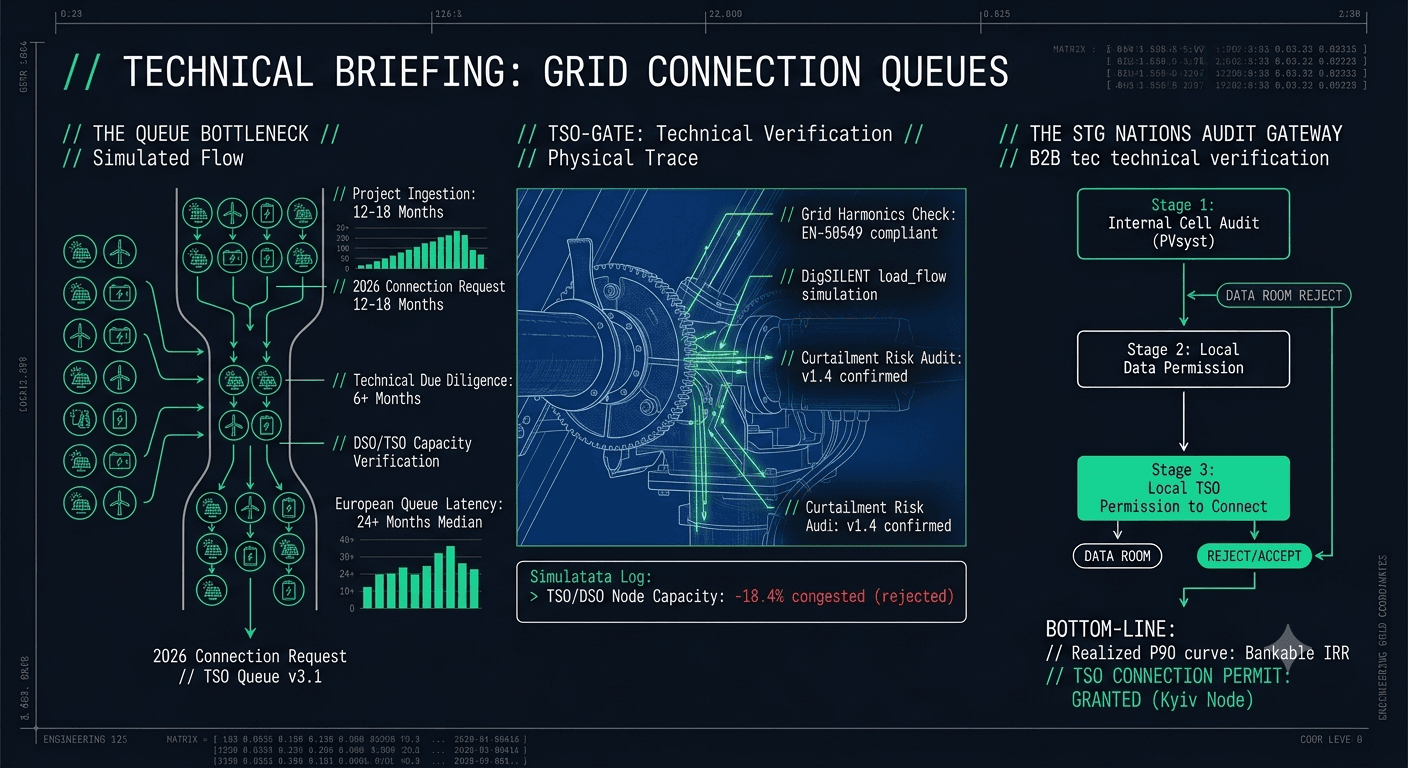
Grid Connection Queues in Europe: The Bottleneck No Financial Model Accounts For
Across Europe, the gap between permitted renewable energy capacity and connected capacity has reached a critical level. In Spain, over 180 GW of solar projects hold grid access permits. Installed capacity is under 30 GW. In Germany, average grid connection timelines for utility-scale projects have extended from 18 months in 2021 to over 36 months today.
This is not a permitting problem. It is an infrastructure problem — and it has direct consequences for investment returns.
Why queue position is not what it appears
Grid connection rights are allocated by application date in most European markets. In practice, queue position is less reliable than it looks. Projects ahead of you in the queue may be stalled, underfunded, or awaiting land permits — but they still hold their position. Until a project formally withdraws or lapses, it occupies bandwidth in the network operator's planning model.
In Italy, the Gestore dei Servizi Energetici reported in early 2026 that over 60% of projects in the grid queue had been inactive for more than 12 months. Similar figures apply in Poland and Romania.
The technical review most investors skip
When acquiring a project with grid connection rights, most due diligence focuses on the permit document itself — the connection agreement, the capacity allocation, the voltage level. What rarely gets checked is the actual load flow study underpinning the connection.
A load flow study shows how the network operator modelled the connection at the time of approval. If the network has changed since — new projects connected, line upgrades delayed, transformer capacity reallocated — the original study may no longer reflect the real technical feasibility of the connection.
STG Nations includes grid connection verification in every Technical Due Diligence engagement. We review the original load flow study, check it against current network data from the relevant TSO or DSO, and flag where the connection assumptions may require renegotiation.